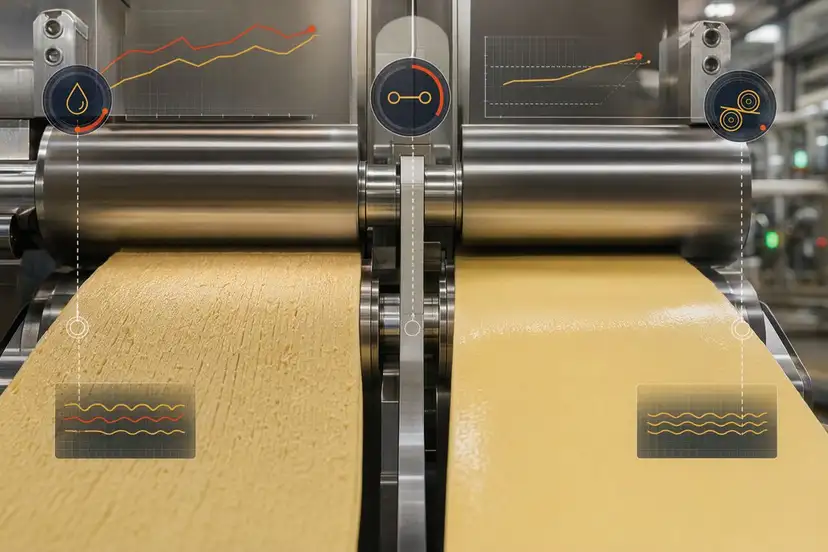
Noodle Dough Stickiness & Sheeting Cracking | StrandPilot
Troubleshoot sticky noodle dough, rough sheets, edge cracking, poor lamination, weak strands, and inconsistent cuts with StrandPilot enzyme support for noodle manufacturing.
Request pricing Troubleshoot sticky noodle dough, rough sheets, edge cracking, poor lamination, weak strands, and inconsistent cuts with StrandPilot enzyme support for noodle manufacturing.
Request pricingSticky dough, rough sheet surfaces, cracked edges, and weak noodle strands are rarely caused by one variable. In a noodle factory, small shifts in flour quality, water absorption, mixing energy, resting time, roller gap, and steam or drying conditions can quickly show up as unstable sheeting and inconsistent finished texture.
StrandPilot is an enzyme supplier for noodle manufacturing that helps R&D and production teams connect these symptoms to formulation decisions. Our role is practical: support flour variability management, dough handling, strand strength, cooking performance, and scale-up from bench trials to continuous production.
If your line is fighting sticky dough, edge cracking, poor lamination, weak strands, or inconsistent cut quality, use the decision-tree below to narrow the likely cause and identify where enzyme adjustment may help.
Request a quote for noodle enzyme support matched to your flour, process, and target texture.
A noodle sheet must be cohesive enough to laminate and cut cleanly, but not so tacky that it clings to rollers, cutters, transfer belts, or dusting systems. It also needs enough extensibility to pass through progressive reduction without tearing, while maintaining bite firmness after cooking.
When that balance shifts, factories often see:
Enzyme systems can help when the root issue involves dough rheology, arabinoxylan behavior, gluten network balance, starch-water interaction, or lipid-mediated texture development. They are not a substitute for correct hydration, roller setup, or flour specification, but they can widen the processing window.
Typical signs
Check first
Where enzymes may help
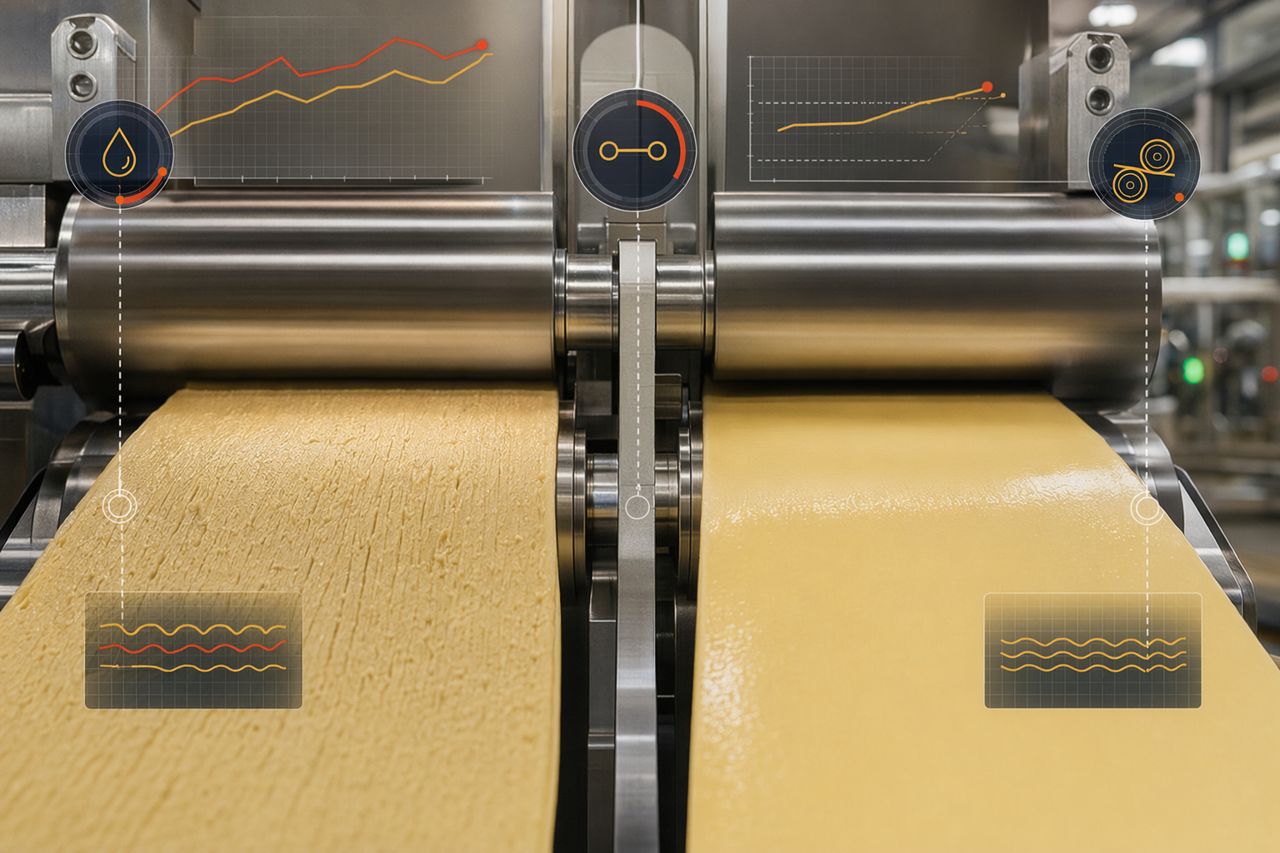
A tailored hemicellulase or xylanase approach can help manage water distribution by modifying non-starch polysaccharide behavior in wheat flour. In the right dosage window, this can improve dough handling, reduce surface tack, and support smoother sheet formation.
For some formulas, controlled protease support may improve dough relaxation when the gluten network is too tight, helping the sheet pass through reduction with less drag. The key is control: too much relaxation can weaken strands and reduce bite.
Practical target
Aim for a dough that feeds evenly, sheets without smearing, and holds a smooth surface without excessive dusting flour.
Typical signs
Check first
Where enzymes may help
Enzyme systems can improve dough continuity by supporting better water binding and more predictable gluten-starch interaction. For instant noodles, this can improve sheet smoothness before steaming and help stabilize strand appearance after cutting.
In alkaline noodle systems or high-protein formulas, enzyme selection must be evaluated against pH, salt, mixing intensity, and target bite. StrandPilot helps screen options against your actual process conditions rather than relying on a one-size-fits-all recommendation.
Practical target
A continuous, glossy sheet surface with clean reduction behavior and minimal tearing before cutting.
Typical signs
Check first
Where enzymes may help
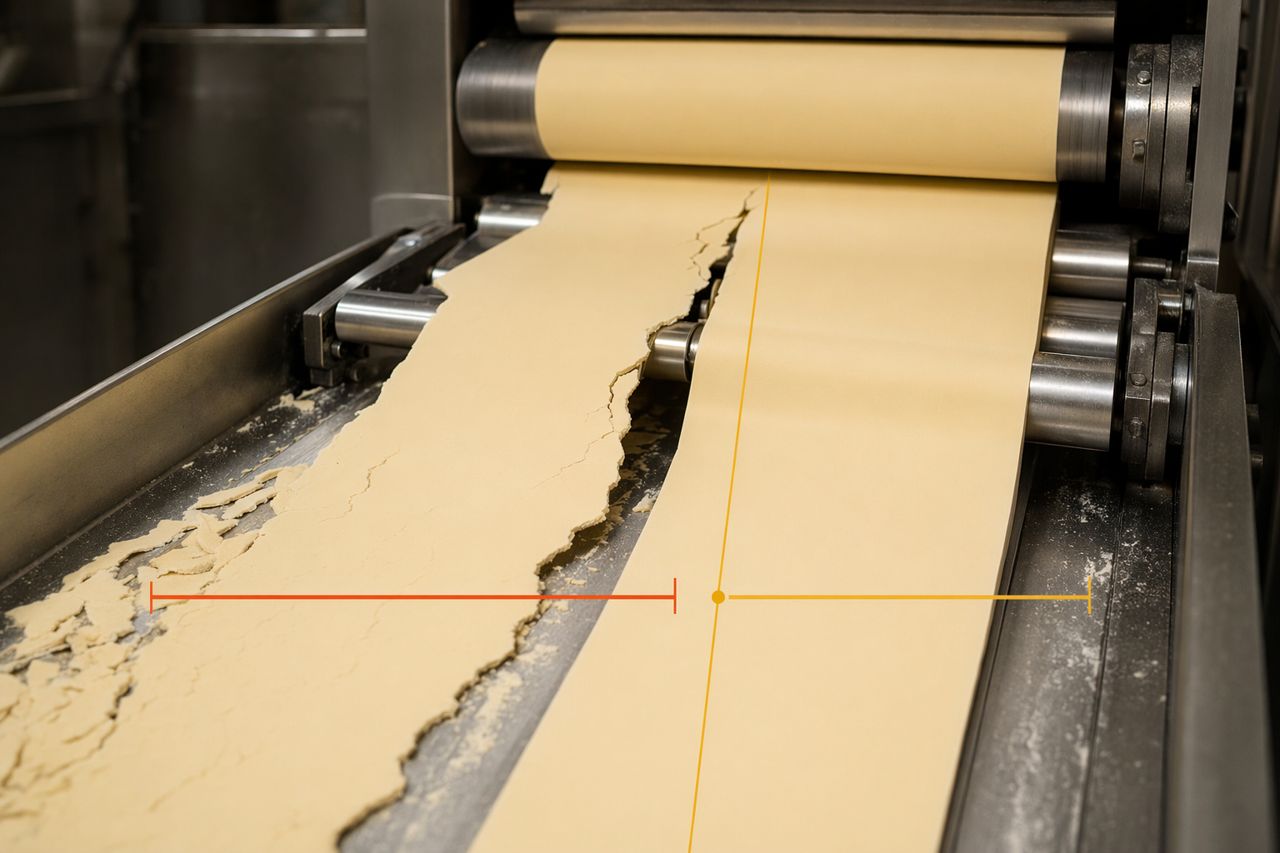
Edge cracking often reflects insufficient extensibility or uneven hydration. A carefully selected enzyme blend can help the dough stretch through reduction without losing structural integrity. For factories working with variable wheat lots, this can reduce the need for constant roller and water adjustments.
When the gluten network is overly tight, controlled relaxation can support lamination. When the network is weak, the enzyme strategy must avoid over-softening and instead focus on improving sheet cohesion and water balance.
Practical target
Stable edges through progressive reduction, lower trim, and more uniform strand strength across the full sheet width.
Typical signs
Check first
Where enzymes may help
If lamination failure is linked to dry surface behavior or inconsistent dough cohesion, enzyme-supported water distribution can help. The goal is not to make the dough softer everywhere; the goal is to create a sheet surface that bonds predictably while retaining enough structure for cutting and downstream handling.
Practical target
Clean layer bonding with no visible separation, stable reduction after folding, and fewer weak points in finished noodle blocks.
Typical signs
Check first
Where enzymes may help
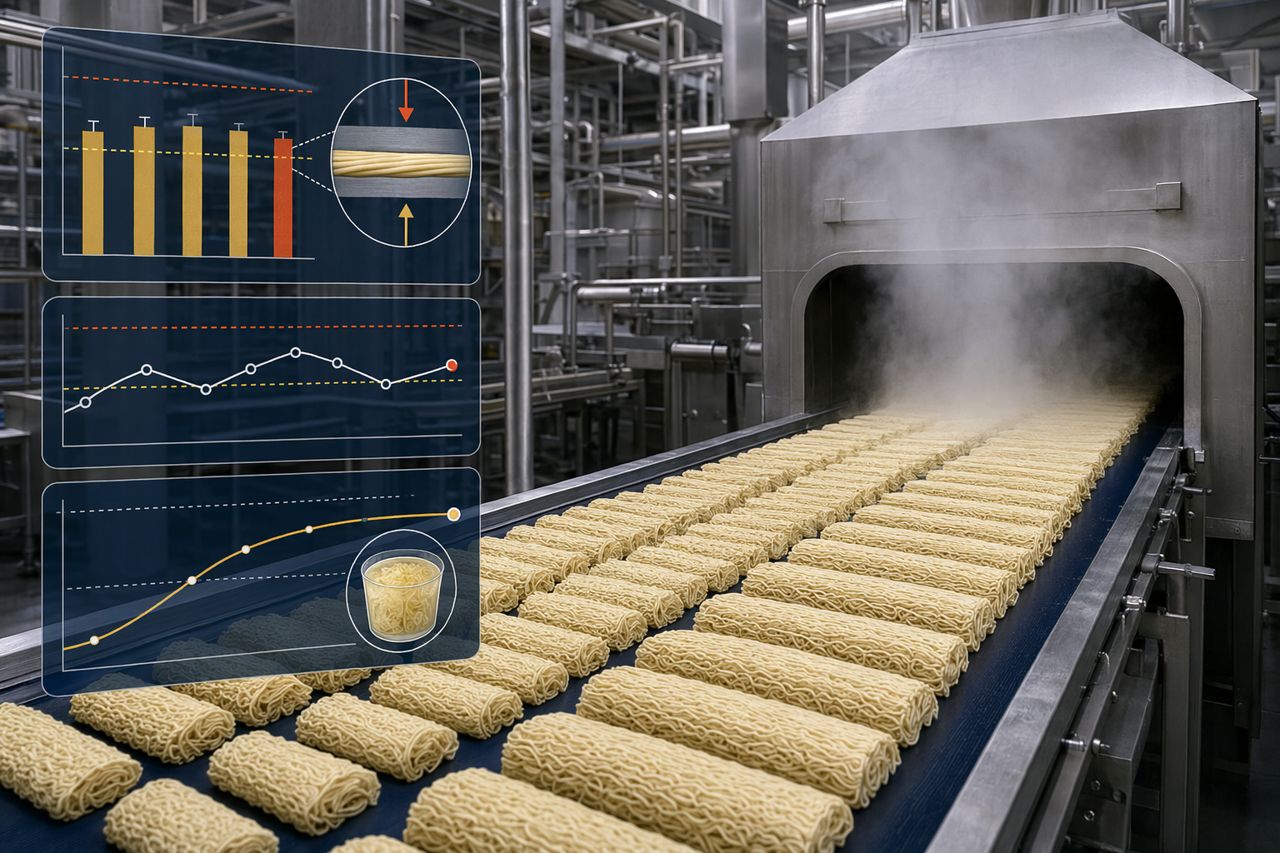
A noodle enzyme system should preserve enough bite and strand strength after cooking. Depending on the flour and process, StrandPilot may recommend enzyme support for improved sheet integrity, smoother cutting, controlled relaxation, or better textural consistency after rehydration.
For fried instant noodles, enzyme selection must also be evaluated against expansion, block structure, oil uptake tendency, and rehydration speed. For air-dried or steamed noodles, the focus may shift toward breakage reduction, cooking loss, and bite firmness.
Practical target
Cleanly cut strands with stable handling before steaming and predictable bite after cooking or rehydration.
StrandPilot supplies enzyme solutions for noodle manufacturing with a focus on factory outcomes, not isolated lab claims. We work with R&D, QA, procurement, and plant teams to translate texture targets into workable formulation and process guidance.
Every recommendation depends on your flour, noodle style, mixing system, resting time, sheeting schedule, steaming or drying conditions, and finished product specification.
To build a practical troubleshooting plan, StrandPilot typically asks for:
From there, we can suggest a starting enzyme direction, trial design, and evaluation checklist.
A useful noodle enzyme trial should compare more than one variable, but it should not overload the production team. StrandPilot recommends a controlled structure:
Define the defect clearly
For example: sticky dough at feed-in, edge cracking after second reduction, ragged cut strands, or excessive breakage after frying.
Set the texture target
Define what success means: smoother sheet, less trim, clean cut, stronger strand, faster rehydration, firmer bite, or lower cooking loss.
Hold process settings stable where possible
Keep water addition, mixing time, rest, roller gaps, steam, and drying or frying conditions as consistent as practical.
Run side-by-side comparisons
Compare the current formula with selected enzyme options under the same line conditions.
Evaluate both line behavior and eating quality
A dough that sheets well but loses bite is not a successful noodle solution.
Confirm at production speed
Bench or pilot results must be validated under real sheeting, cutting, steaming, drying, frying, and packaging loads.
A sticky mixer discharge, a sticky sheet, and sticky strands after steaming may require different corrective action. Start by locating the first point where the defect appears.
A dough that feels easier to sheet may become too weak during cutting or cooking. The best enzyme approach balances relaxation with strand strength.
A dosage window that works on one flour may need adjustment when protein quality, damaged starch, ash, or bran fine content shifts. StrandPilot helps design trials with flour variability in mind.
Noodle success is measured at the line and in the bowl: sheeting, cutting, block formation, cooking loss, rehydration, bite, and sensory consistency all matter.
If sticky dough, rough sheets, cracking, poor lamination, or weak strands are slowing your noodle line, StrandPilot can help you evaluate the right enzyme direction.
Use the on-site request form and tell us your noodle type, main defect, flour profile, and target texture. Our team will respond with a practical recommendation path and quote.
Request a quote for StrandPilot noodle enzyme solutions and troubleshooting support.
Tell us your application and volume — we reply with pricing and lead time.
We have received your message. We will reply by email.