Instant Noodle Product Development Checklist for New SKUs
Launching a new instant noodle SKU is rarely a single formulation decision. It is a controlled handoff between consumer texture goals, dough handling, sheeting behavior, steaming, drying or frying, packaging stability, and rehydration performance.
For R&D teams, the challenge is to make each variable measurable enough for pilot trials and predictable enough for full-line production.
StrandPilot works as an enzyme supplier for noodle manufacturing with a practical focus: helping noodle factories translate flour variability, process constraints, and texture targets into repeatable production outcomes.
Use this checklist when developing a new fried, air-dried, cup, bowl, or pouch instant noodle SKU.
1. Define the eating target before changing the formula
Before enzyme selection, flour adjustment, or process tuning, define the finished eating experience in factory language.
Texture and sensory targets to lock first
- Initial bite firmness after standard rehydration
- Elasticity during chewing
- Surface smoothness and slipperiness
- Strand separation after cooking
- Resistance to sogginess during hold time
- Broth clarity and cooking loss control
- Flavor release from seasoning and oil systems
- Texture consistency between first bite and final bite
A clear texture target prevents the trial process from becoming a sequence of unrelated formula changes.
Development question
Can the R&D team describe the new SKU as a measurable strand profile, not only as a consumer concept?
2. Map the flour and starch baseline
Flour quality drives dough strength, sheet behavior, hydration speed, and final noodle bite. Instant noodle lines often need to handle seasonal wheat variation, supplier changes, and cost-optimized blends without disrupting production stability.
Baseline checks for new SKU work
- Protein quality and gluten strength fit for sheeting
- Starch contribution to bite and rehydration
- Damaged starch impact on water absorption
- Ash level and color expectations
- Lot-to-lot consistency of flour behavior
- Compatibility with added starches or specialty flours
Where enzymes can help
Enzyme systems may support dough extensibility, sheet uniformity, strand texture, and cooking performance when flour variation creates instability. The goal is not to mask poor raw material selection. The goal is to create a broader, more reliable processing window.
3. Set the dough handling window
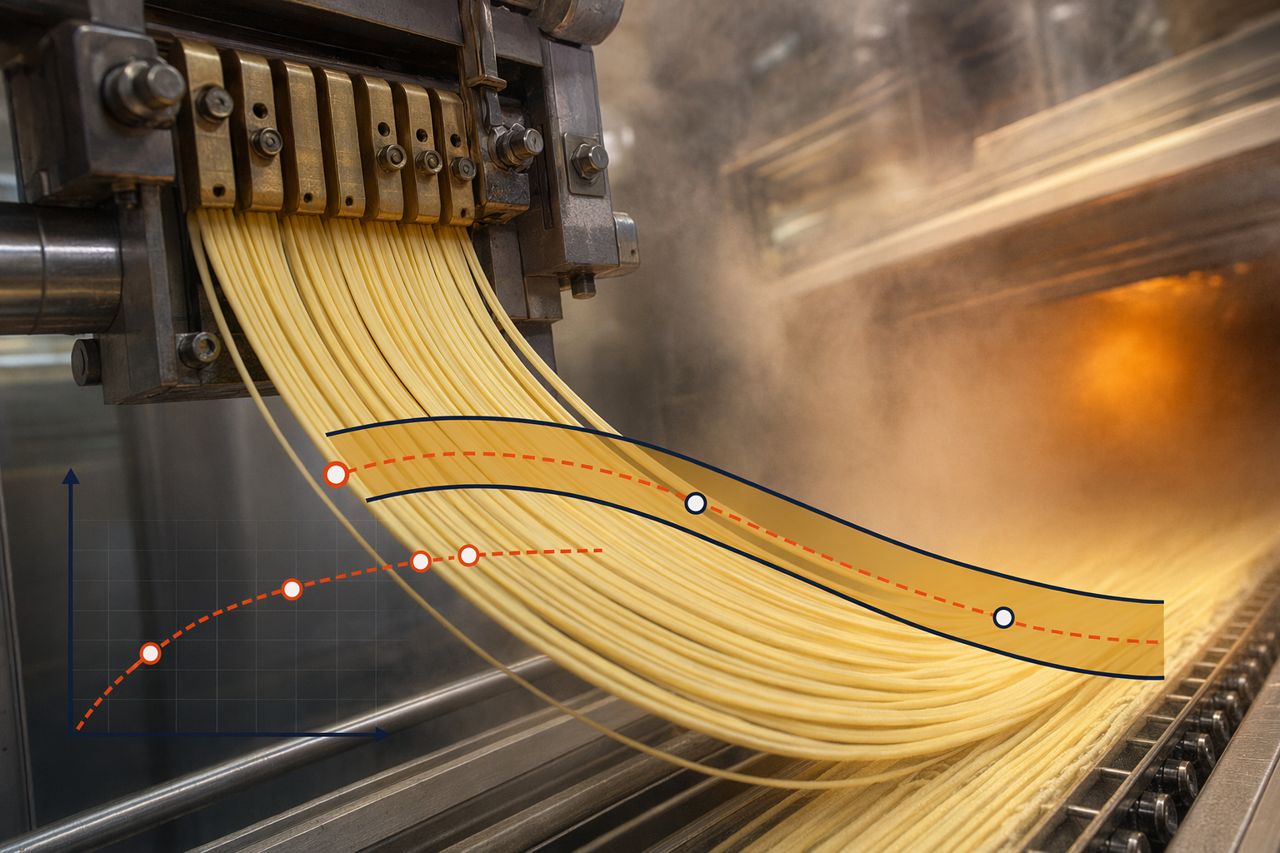
A good instant noodle SKU must be manufacturable at line speed. The dough should mix cleanly, rest predictably, sheet without tearing, and cut into strands without excessive fines or deformation.
Dough-stage checklist
- Hydration curve is suitable for mixer design and batch timing
- Crumb size supports consistent feeder loading
- Dough sheet forms without dry pockets or wet streaks
- Roller pressure can be maintained without sheet cracking
- Sheet thickness variation stays within the plant’s tolerance
- Strands separate cleanly at the cutter
- Rework, trim, and fines remain controlled
Enzyme development focus
For noodle factories, enzyme selection should be evaluated against line behavior, not just bench dough feel. The right enzyme approach can improve processing tolerance by influencing dough extensibility, surface condition, and internal structure formation during sheeting and steaming.
4. Match enzyme strategy to the SKU objective
Different instant noodle SKUs need different enzyme logic. A cup noodle built for fast rehydration may not need the same structure as a premium block noodle designed for elastic bite and longer hold time.
Common formulation objectives
Improve bite and elasticity
Use enzyme evaluation to support a stronger, more resilient strand structure while maintaining manufacturable dough handling.
Reduce cooking loss and broth cloudiness
Focus on strand integrity, starch behavior, and surface stability during rehydration.
Improve sheetability with variable flour
Use enzyme systems to widen the processing window and reduce tearing, rough surfaces, or unstable sheet flow.
Support faster or more even rehydration
Balance internal structure, strand porosity, and texture retention after hot-water preparation.
Improve texture after storage
Evaluate how noodle blocks perform after packaging, transport, and shelf-life conditions, not only immediately after production.
5. Build trials around process reality
A reliable new SKU trial should reflect how the noodle factory actually runs.
Trial conditions to document
- Flour lot and blend ratio
- Water addition and mixing profile
- Rest time before sheeting
- Roller gap sequence
- Final sheet thickness
- Strand width and shape
- Steam time and temperature profile
- Drying or frying conditions
- Cooling and packaging timing
- Rehydration instructions used for evaluation
Why this matters
If the trial method changes from one run to the next, enzyme performance becomes difficult to interpret. StrandPilot supports R&D teams by helping define practical comparison points: control formula, enzyme-adjusted formula, processing observation, sensory result, and scale-up risk.
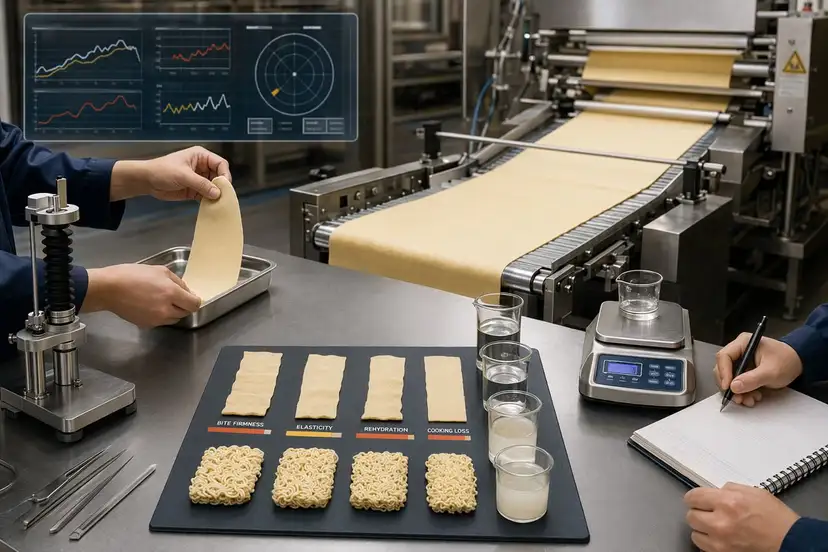
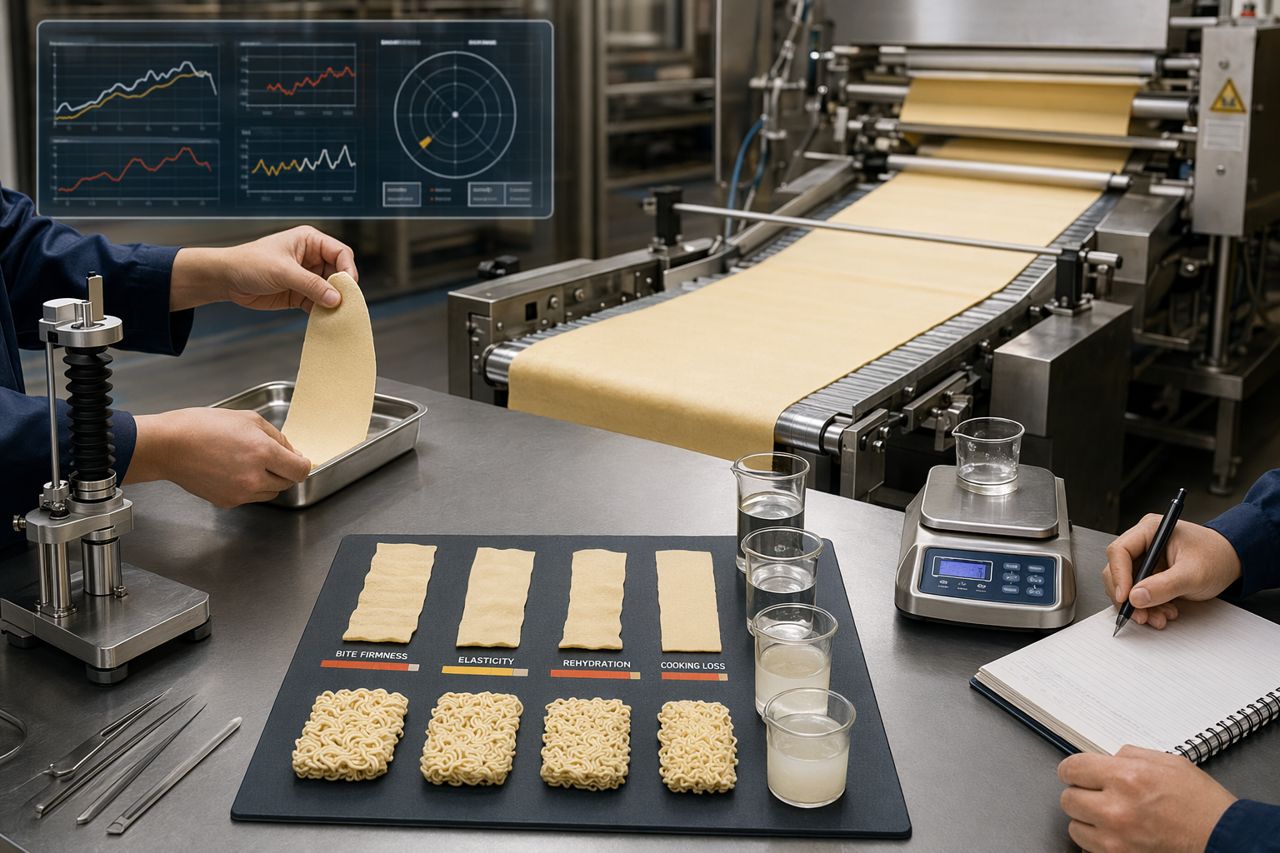
6. Evaluate texture with production-facing criteria
Consumer panels matter, but early R&D screening should be built around texture criteria that can be repeated in the plant.
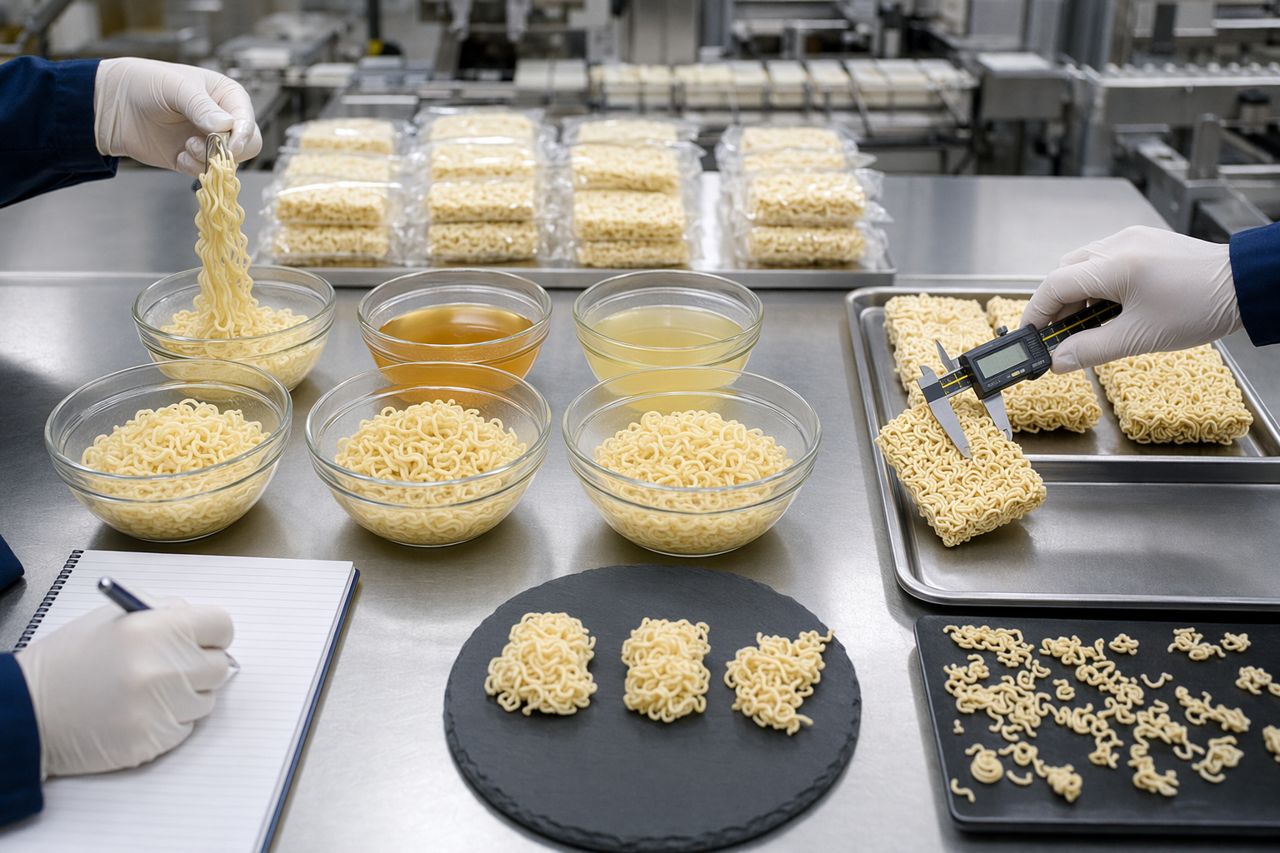
Recommended noodle evaluation points
- Dry block appearance and compactness
- Strand breakage after packaging simulation
- Rehydration speed and uniformity
- Bite firmness at target preparation time
- Elastic recovery during chewing
- Surface smoothness
- Strand separation in broth
- Cooking loss and broth turbidity
- Texture hold over several minutes
- Sensory consistency between batches
A strong SKU does not only taste good in the lab. It performs consistently after steaming, drying or frying, cooling, packing, shipping, and consumer preparation.
7. Watch for common scale-up failures
New instant noodle SKUs can pass bench trials and still create line problems during scale-up.
Failure points to monitor
- Dough too tight for smooth sheeting
- Dough too relaxed, causing sheet deformation
- Roller load changes after rest time
- Strands sticking before steaming
- Excess surface roughness after cutting
- Uneven steaming response across the sheet
- Excessive oil uptake in fried noodles
- Brittleness after drying or frying
- Texture loss during hot-water hold
- Sensory drift after storage
Practical response
Do not treat these as isolated defects. Each issue may be connected to flour quality, hydration, mixing, enzyme choice, and thermal processing. The most useful development path is one that connects formulation decisions to equipment behavior.
8. Create a decision matrix before final approval
A new SKU should move forward only when it meets both eating-quality and factory-readiness requirements.
Suggested R&D decision matrix
| Decision area |
Pass criteria |
| Texture target |
Bite, elasticity, smoothness, and hold time match the brief |
| Process stability |
Dough, sheet, cutter, and steam stages remain stable at trial speed |
| Cooking performance |
Rehydration, strand separation, and broth clarity meet target |
| Sensory consistency |
Multiple samples show repeatable eating quality |
| Packaging resilience |
Blocks withstand normal handling and storage conditions |
| Cost fit |
Formula supports commercial margin requirements |
| Scale-up confidence |
Trial results can be transferred to plant conditions |
This matrix helps R&D, procurement, production, and quality teams make decisions from the same evidence.
9. Involve your enzyme supplier early
The best time to involve an enzyme partner is before the formula has become overloaded with corrective ingredients. Early input can reduce trial loops and help identify which texture issues are formulation-driven, process-driven, or raw-material-driven.
As an enzyme supplier for noodle manufacturing, StrandPilot supports instant noodle teams with:
- Enzyme selection based on SKU texture goals
- Trial planning for bench, pilot, and line validation
- Guidance on dough handling and sheeting observations
- Support for flour variability and process-window development
- Texture and cooking-performance troubleshooting
- Scale-up recommendations for factory implementation
Our role is not to add complexity. It is to help your team make enzyme use predictable, practical, and aligned with the noodle line.
Instant noodle SKU development checklist
Use this condensed checklist before approving a new instant noodle formulation for plant scale-up.
Product target
- [ ] Eating texture is defined in measurable terms
- [ ] Rehydration method is standardized
- [ ] Hold-time texture requirement is defined
- [ ] Broth clarity or cooking-loss target is set
Raw materials
- [ ] Flour specification is confirmed
- [ ] Starch or specialty flour role is defined
- [ ] Lot-to-lot flour variation has been considered
- [ ] Cost target is aligned with procurement
Dough and sheeting
- [ ] Mixing and hydration behavior are stable
- [ ] Dough rest time is appropriate for the line
- [ ] Sheet forms smoothly through rollers
- [ ] Cutting quality and strand separation are acceptable
Thermal process
- [ ] Steaming profile supports final texture
- [ ] Drying or frying conditions are compatible with strand structure
- [ ] Block shape and density meet packaging needs
- [ ] Breakage risk is controlled
Enzyme evaluation
- [ ] Enzyme objective is clearly defined
- [ ] Control and trial formulas are compared under the same conditions
- [ ] Dough behavior is documented, not only final texture
- [ ] Cooking performance is evaluated after realistic processing
- [ ] Scale-up risks are reviewed before approval
Commercial readiness
- [ ] Sensory result matches the market brief
- [ ] Production team has reviewed handling impact
- [ ] Quality team has defined release criteria
- [ ] Procurement understands raw-material sensitivities
- [ ] Final formulation is ready for line validation
Turn new noodle concepts into factory-ready SKUs
New instant noodle development works best when R&D, production, and quality teams share the same technical map. StrandPilot helps noodle manufacturers connect enzyme strategy to texture targets, line stability, cooking performance, and scale-up confidence.
If you are developing a new instant noodle SKU or troubleshooting a current launch, request a quote through the on-site form and tell us about your target texture, noodle format, and production constraints.
Request a quote